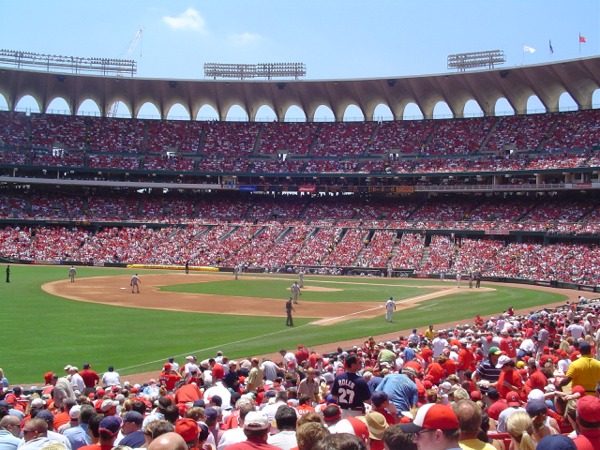
There is a place in downtown St. Louis, between Seventh and Broadway, where the air is thick with ghosts of great players and the atmosphere is charged with moments that defined baseball. Here a stadium once stood, home to the St. Louis Cardinals during one of their strongest eras, known as Busch Stadium. It was in this space that Bob Gibson once struck out seventeen batters in the first game of a World Series and also where he pitched his 3000th strikeout. It was the ground upon which the ever elusive Lou Brock raced against a catcher’s throw to steal a base 118 times in one season and swung the bat to record his 3000th hit. Thousands of people would gather to see Ozzie Smith dart out onto the field and perform his characteristic back flip at the start of a home game. The air still prickles with the electricity generated by a stadium full of fans going crazy in 1985 after Ozzie hit a miraculous left handed home run to clinch the National League Championship. Thousands of camera flashes lit up the night on September 9 1998, as Mark McGwire launched a line drive over the wall in left field to break the historic single season home run record. And there are echoes in this space of the beloved, cracked voice of Cardinal announcer Jack Buck comforting a grieving nation and assuring them that the game must go on after 9/11. Although the stadium no longer stands, the ghost of the building and what it stood for remains fondly intact in the minds of many.
In 1966, Busch Memorial Stadium (also known as Busch Stadium II) became the second stadium to house the St. Louis Cardinals. Designed by St. Louis based engineering firm Sverdrup and Parcel, the new stadium was to replace the aging Sportsman Park. When August Busch acquired the St. Louis Cardinals in 1953, he renamed Sportsman Park to Busch Stadium and began plans to build a new home for his team. Downtown St. Louis was the spot chosen and construction began in 1964. Initially, the stadium was to be used as a baseball only facility, but original designs were altered and Busch Memorial Stadium also became home to the NFL team also named the St. Louis Cardinals.
A prominent building nestled down among the tall skyline of downtown St. Louis, the new stadium spanned a radius of 800 feet and was built in the “cookie cutter” style popular in the mid twentieth century. There was one feature, however, that set it apart from others of the same style and became an endearing landmark in the hearts of St. Louis fans. Ninety-six arches adorned the top of the stadium. Designed by Edward Durrell, famed architect of Radio City Music Hall, these arches mimicked the Gateway Arch, which fans could see from the upper terrace in right field. The playing field was grass for four seasons until replaced with artificial turf in 1970. The infield stayed as a dirt playing surface until it was also carpeted in 1976. Groundskeepers returned the field to its original grass state in 1995, which would remain until the stadium was demolished.
May 12 1966 saw the inaugural game of Busch Memorial Stadium, a twelve inning outing in which the Cardinals defeated the Atlanta Braves 4-3. For the next twenty one years, the stadium was utilized year round by both the St. Louis Cardinals baseball and football teams. In 1987, the NFL Cardinals acquired a new home of their own and the stadium underwent construction to define itself as a baseball only arena, even giving the seats a face lift by replacing them with ones painted Cardinal red.
Busch Stadium’s illustrious history includes a monumental concert by the Beatles, six World Series and it was the proud host of the All Star game during its first year. Many Hall of Famers called the stadium home and it was considered a mecca for millions of Cardinal fans who flocked through the gates to fill the stadium every season to see their beloved Redbirds. By the turn of the century, however, the stadium had become costly to maintain, falling into various states of disrepair, and it became clear that the St. Louis Cardinals would need a new nest. 2005 was slated to be the last season for the Cardinals’ home. On November 7 2005, only two weeks after the Cardinals lost a heartbreaking division playoff series, a wrecking ball tore into the side of the stadium and demolition began. Even though the building no longer stands, part of the footprint was incorporated into the new stadium and fans can see outlines upon the sidewalk of where the outfield used to be. Much of the former grounds has been converted into parking lots and entertainment centers, but the events and great moments that took place there still live on in the hearts of millions.
 cardinal chick